
You've rewritten that hero headline three times this week. Traffic arrives, visitors scroll, and then they vanish like pixies at dawn, while two teammates argue in Slack about whether the button or the offer is to blame. Guessing won't settle it. Learning how to do A/B testing gives you a fair duel between versions, so real visitor behavior picks the winner instead of the loudest opinion in the room.
Table of Contents
- The Spellbook for A/B Testing
- Writing Hypotheses and Crafting Variants Worth Testing
- Sample Size, Significance, and Traffic Allocation Demystified
- Stopping Tests Without Getting Tricked by Peeking
- Manual vs Automated A/B Testing and Where the Conversion Alchemist Fits
- A Real Spell Cast Inside Web Mage From Prompt to Promoted Winner
- Becoming an Always-On Mage of Experimentation
The Spellbook for A/B Testing
A stalled landing page usually isn't cursed. It's unclear. Visitors may not understand the offer, trust the proof, or spot the next step, and you can't tell which problem matters by staring at the page harder. An A/B test splits eligible visitors randomly between your current page, the control, and one changed version, the treatment. Because both run at the same time, you can compare outcomes without blaming a weekday, a campaign, or a passing dragon for the difference.
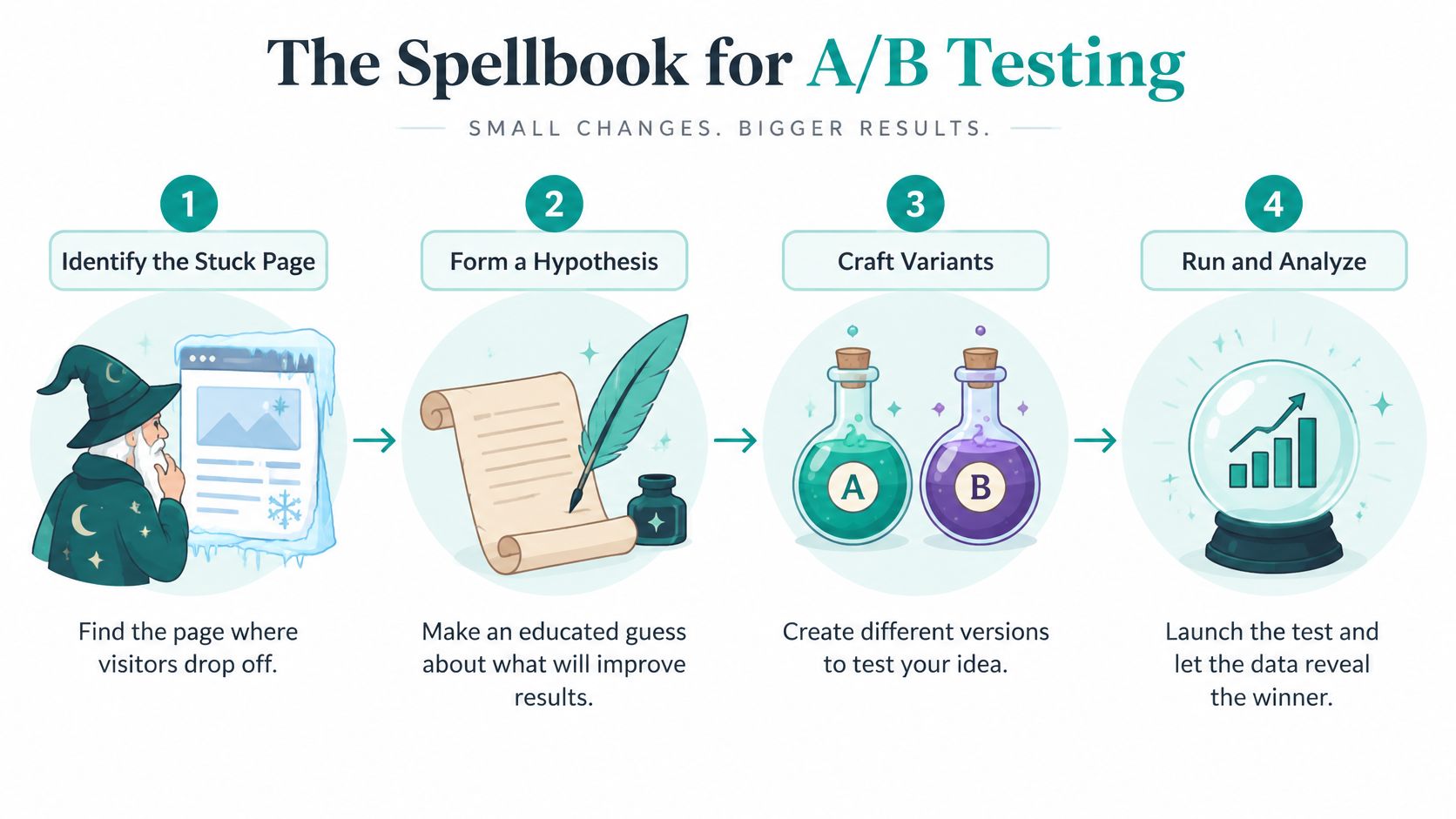
Think of the process as an eight-step ritual rather than a quick trick. You spot a stuck page, inspect evidence, write a hypothesis, define success, size the test, randomize traffic, monitor guardrails, and decide using a rule set before launch. Skip the sizing step and you might stop on noise. Skip tracking checks and your crystal ball may be recording the wrong event entirely.
The four-part flow below condenses that ritual for your first cast.
Why Randomness Is Your Shield
Random assignment matters because audiences aren't identical hour by hour. Paid clicks in the morning may behave differently from returning customers at night. Randomly assigning users to mutually exclusive arms, preserving their assignment when they return, and validating event tracking all protect the comparison, as described in Optimizely guidance on calculating A/B test sample size. An A/A test, where both arms show the same experience, can also expose routing or instrumentation bias before you risk a real decision.
Guild rule: A test doesn't prove a page is universally better. It estimates whether one specific change improved one specific outcome for the audience you exposed.
That discipline serves more than conversion specialists. A solo founder can settle pricing page debates without hiring a growth team. An agency mage can show clients evidence instead of taste. A SaaS marketer can learn whether a claim attracts qualified trials, not just curious clicks.
Start with pages that already receive meaningful traffic and sit close to revenue, such as checkout, pricing, demo, or lead capture pages. A tiny change on a rarely visited page may be real magic, but you'll wait a very long time to know.
Writing Hypotheses and Crafting Variants Worth Testing
"Let's try a new headline" isn't a hypothesis. It's a wish muttered over a cauldron. It names no audience, predicts no outcome, and gives you no way to be wrong, so almost any result can be twisted into a lesson afterward.
Use this scroll instead: If we change X for audience Y, then metric Z will move because reason B. The "because" forces you to connect the edit to a visitor problem you've observed in analytics, session recordings, support chats, or user interviews.
Here's a checkout example. If we move shipping costs and the returns promise beside the payment button for first-time mobile shoppers, then completed purchases will rise because visitors won't leave checkout hunting for total cost information. That statement can fail, which is exactly what makes it useful.
The apprentice below is doing what good experimenters do, comparing two defined potions instead of stirring everything together.

Your Pre-Launch Scroll
Copy this checklist into Notion or your project tool before traffic moves:
- Primary metric: Name one decision outcome, such as purchase completion or qualified demo booking.
- Baseline: Record the current rate for that exact metric and audience.
- Meaningful change: Make the challenger different enough that visitors can notice it and your traffic can detect it.
- Guardrails: Choose harms you'll watch, such as refunds, cancellations, page speed, or downstream revenue.
- Stopping rule: Write when you'll decide, and what counts as inconclusive, before anyone sees early results.
Change one meaningful element when traffic is limited. If you rewrite the headline, swap the image, shorten the form, and add a discount at once, a win won't tell you which ingredient worked. With more traffic, you can draft several challengers, but each extra variant divides visitors further and needs its own sample.
Good variant craft also respects usability. A louder button that confuses the journey isn't clever alchemy, and the principles in this guide to conversion rate optimization and UX can help you separate persuasive clarity from visual noise. Keep everything else stable, including audience rules, pricing, and campaign targeting, while the test runs.
Sample Size, Significance, and Traffic Allocation Demystified
The math frightens many apprentices because four knobs seem to move at once. They don't. You set each knob before launch, then a calculator tells you how much evidence your chosen question requires.
Your baseline conversion rate is how often visitors already convert. Your minimum detectable effect, or MDE, is the smallest improvement worth acting on. Your significance threshold controls how often you're willing to call a random wobble a win. Your statistical power is your chance of detecting the stated effect if it's there.
A Worked Example You Can Copy
A common design uses a two-sided significance level of 0.05 and 80% power, and a 3% baseline with a 10% relative MDE at 95% confidence can require approximately 15,500 sessions per variant, or 31,000 total, according to the sample size reference already cited in the opening section. That number surprises people, and that's the point. Detecting a small relative lift on a low baseline takes patience.
Relative language also trips readers up. An experiment with a 5% baseline and 10% relative MDE targets roughly 5.5%, not 15%, and a control plus one challenger means doubling the per-variant requirement, as explained in Optimizely documentation on how long to run an experiment. If your site can't supply that sample in a sensible period, test a bigger, more consequential change instead of hunting for a tiny copy sparkle.
| Baseline CR | Relative MDE | Sessions per variant | 95% confidence |
|---|---|---|---|
| 3% | 10% | Approximately 15,500 | Yes |
| 5% | 10% | Calculate from your baseline and power settings | Set before launch |
Statistical significance is a threshold for unusualness under no real difference, not a certificate that a winner will reign forever. Some experiment settings default to 90% significance, while 95% is widely treated as an accepted standard, and a lower bar can decide sooner while raising false positive risk. Pick your bar before the first visitor arrives.
Splitting the Stream of Visitors
A standard two-arm test gives each version 50% of eligible traffic, which balances evidence gathering, while unequal allocation can limit exposure to a risky variant but slows learning in that arm, as set out in this explanation of A/B testing traffic allocation. Calendar time then depends on eligible traffic reaching the slower arm. Treat the calculator like a divination bowl. It doesn't predict the winner. It reveals whether your question is answerable.
Stopping Tests Without Getting Tricked by Peeking
Your dashboard glows green on day two. The challenger is "winning," someone screenshots it, and the guild wants to promote the variant before lunch. That glowing potion is often just random foam.
Optional stopping means repeatedly checking a fixed-horizon test and ending it as soon as the p-value dips below 0.05. Each peek gives randomness another chance to cross the line, so your real false positive risk grows beyond the nominal threshold described in Optimizely material on its statistics engine. Changing the primary metric mid-test, testing many outcomes without multiplicity control, or slicing segments after seeing favorable results creates the same trap.
One specialist whitepaper analysis reported the false positive rate rising from 5.1% under a planned single analysis to 29.3% with daily checking and significance-based stopping, though that estimate isn't peer reviewed, as noted in the MCP Analytics sample size whitepaper. Treat the exact figures cautiously, but respect the mechanism. If you look often enough, noise will eventually wear a crown.
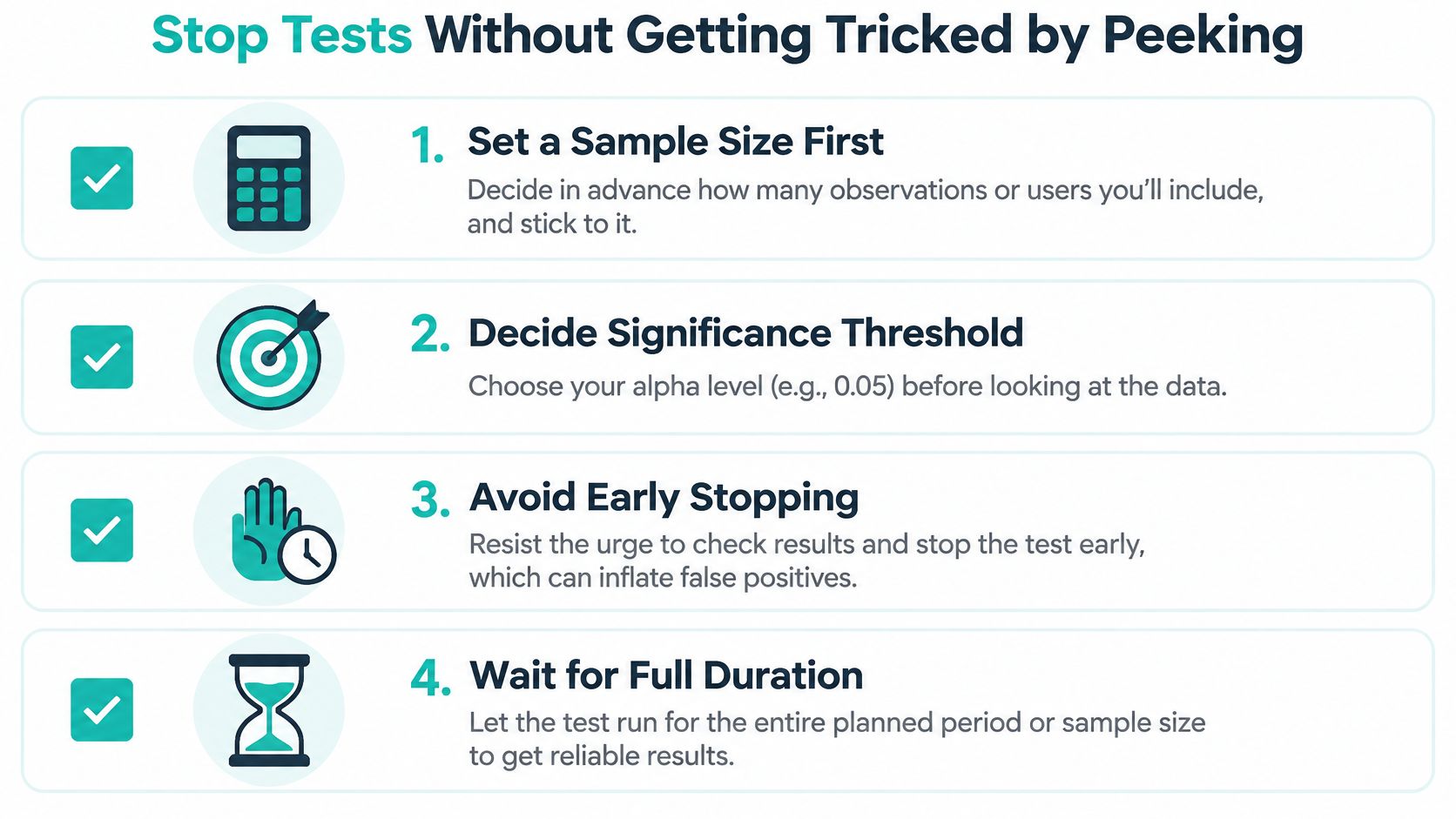
Use this checklist as a lock on the laboratory door.
Choose Your Stopping Law in Advance
For a fixed-horizon test, reach the precomputed sample and planned duration before deciding. If operational pressure requires earlier decisions, use a pre-specified sequential method, alpha-spending approach, always-valid inference, or an explicit Bayesian rule. Don't improvise a sequential policy after peeking. That's just peeking in a fancier robe.
A simple status system helps small teams stay honest:
- Collecting data: Sample or business cycle isn't complete, so no promotion decision yet.
- Eligible for decision: Planned criteria are met and guardrails can be judged.
- Inconclusive: Evidence doesn't separate the variants clearly enough to justify rollout.
The short video below reinforces why patience is part of the method, not a lack of ambition.
Time also protects you from novelty effects. Returning users may react strongly because a design is new, or old habits may temporarily suppress performance. Chart effects by exposure day, compare new and returning visitors, and separate first sessions from repeat sessions before calling a lift durable.
Manual vs Automated A/B Testing and Where the Conversion Alchemist Fits
Running a test by hand can feel like employing three separate familiars who refuse to speak. One tool builds variants, another tracks events, a spreadsheet handles sample math, and a copywriter waits for feedback between each step. That setup can work, especially for unusual product experiments, but the handoffs create places where assignments break and metrics drift.
Manual testing gives you direct control. You choose the platform, inspect implementation, and decide exactly how analysis happens. The cost is labor. Someone must draft variants, QA tracking, preserve returning-user assignment, watch guardrails, and remember not to stop the test because Tuesday looked exciting.
What Automation Should and Shouldn't Do
Automation is strongest at repetitive, rule-bound work:
- Variant drafting: Generate challengers from an approved hypothesis and page context.
- Traffic routing: Maintain the planned split and stable assignment for returning visitors.
- Status tracking: Surface sample progress, primary results, and guardrails such as refund rate or page speed.
- Promotion mechanics: Apply a pre-set decision rule instead of crowning the first variant that flickers green.
Humans should keep the judgment calls. You decide which business problem matters, whether a lift covers engineering or discount costs, and how to respond when conversions rise but customer quality falls. Automation without a valid stopping policy doesn't remove error. It makes the same invalid decision faster, perhaps while wearing a very confident hat.
The workspace below shows the advantage of keeping page creation and experimentation in one castle instead of stitching together disconnected towers.
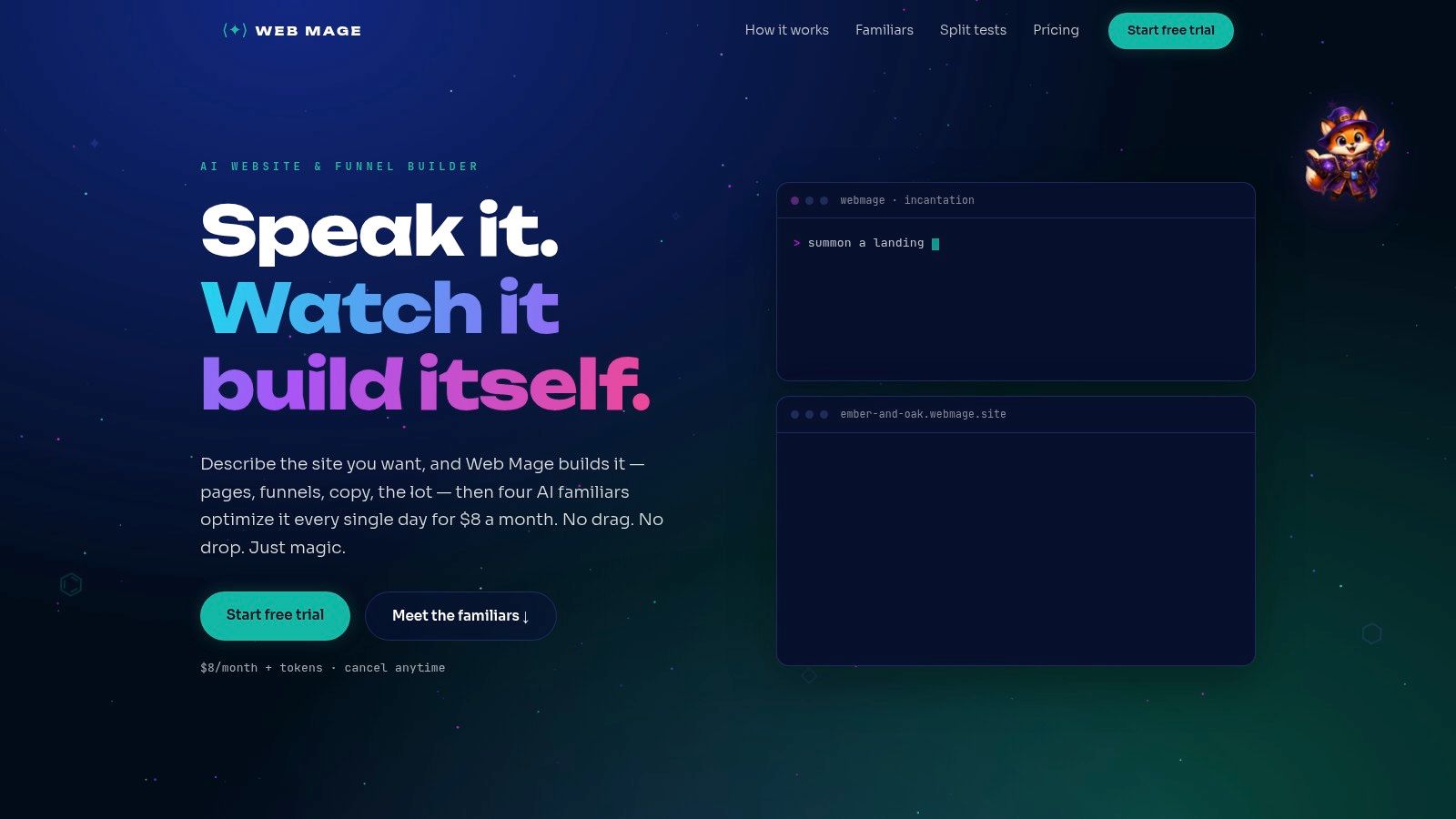
Web Mage is one option in this category. Its Conversion Alchemist drafts A/B variants, allocates traffic, tracks significance, and promotes outperforming variants while retiring underperformers. If you're comparing setups, this overview of A/B testing tools gives you a practical frame for weighing standalone platforms against built-in systems. Whatever tool you choose, ask how it handles assignment persistence, guardrails, sequential monitoring, and inconclusive results before you trust its winner banner.
A Real Spell Cast Inside Web Mage From Prompt to Promoted Winner
Let's cast a complete test the way a solo founder could on Monday morning. You prompt for a landing page for a fictional dragon-riding course, specifying the audience, offer, proof, price, and enrollment action. The generated page becomes your control, not your final answer.
Next, you write the hypothesis in plain language. If the hero names the outcome and time commitment for nervous adult beginners, then enrollment starts will rise because visitors can judge fit without scrolling through the full curriculum. The primary metric is enrollment start. Guardrails include refund rate, page speed, and completed payment, because a bolder promise that attracts mismatched students isn't a healthy win.
From Two Challengers to One Careful Decision
The Conversion Alchemist drafts a challenger with a sharper hero headline. A second idea, a tightened call-to-action block, goes into the backlog rather than the same test, unless your sample plan can support another arm. That's restraint, and restraint keeps cause and effect readable.
Before launch, you validate that enrollment events fire once, confirm returning riders keep their assignment, and check both variants on mobile and desktop. Traffic is allocated evenly, the sample target is set, and the test runs through a normal business cycle. Daily dashboard visits are allowed for broken tracking or alarming guardrails, not for winner shopping.
Statistical significance is a decision threshold, not a guarantee that a winning variant will remain superior forever.
That caution comes from Optimizely guidance for low traffic tests, which also warns against repeatedly checking until a favorable number appears. So the challenger earns promotion only when the planned sample is reached, the confidence interval for the primary metric excludes zero, the effect meets your business threshold, and pre-registered segments don't reveal a serious reversal.
After promotion, keep a small control holdout when the revenue stakes justify it. Plot the effect by exposure day and cohort to watch for novelty decay, a durability check recommended in this discussion of peeking, novelty, and network effects. If the lift fades, you've learned something valuable. Roll back, revise the hypothesis, and cast again with better evidence.
Becoming an Always-On Mage of Experimentation
One successful test doesn't make an experimentation program, just as one levitation spell doesn't make a wizard. The compounding habit looks like this: find a friction point, write a falsifiable hypothesis, size the test, randomize, wait for the planned decision point, inspect guardrails, promote or archive, then turn the learning into the next question.
A manageable cadence for a small team is one well-designed test at a time on a high-value page, with a backlog ranked by evidence and business impact. Record losers and inconclusive tests too. A failed headline may reveal that visitors cared about price certainty, which becomes a stronger hypothesis for the next round.
Let the Rest of the Guild Feed Your Backlog
Experimentation works better when nearby specialists keep the castle sound. The Speed Sprite keeps pages fast so a persuasive winner isn't undermined by slow loading. The SEO Seer repairs metadata and broken links so qualified traffic keeps arriving. The Analytics Oracle flags drop-offs and popular sections that deserve fresh hypotheses.
That broader rhythm connects testing with the practical habits in this guide on how to optimize conversion rate. You're no longer redesigning by moon phase. You're maintaining a ranked queue of uncertainties and retiring them one by one.
When traffic grows, advanced paths open up, including holdout testing, cluster randomization for interference, geographic splits, switchback designs, and multi-armed bandits for short-lived choices. Don't start there merely because the names sound powerful. Master the humble two-arm experiment first. Most durable gains come from clear questions, honest stopping rules, and a guild that keeps showing up after the first result disappoints.
Ready to stop arguing with your landing page and start letting visitors cast the deciding vote? Web Mage generates your pages and funnels from plain-language prompts, then its Conversion Alchemist drafts variants, routes traffic, tracks significance, and promotes winners while companion agents watch speed, SEO, and analytics. Visit today and turn your next stuck page into your first disciplined experiment.