
Only 20% of respondents considered their customer journey effortless in a NielsenIQ customer-journey study, while approximately one-third said it was very consistent. That gap is where differentiators in business stop being slogans. Say two shops sell the same candle at the same price. One loads fast, remembers the cart, and finishes checkout without a maze. The other makes the buyer hunt. Customers don't praise the candle. They repeat the journey that didn't fight them, and they tell friends which shop felt easy.
Table of Contents
- What Makes Differentiators in Business Matter
- A Field Guide to Defensible Differentiators
- How to Cast a Differentiator That Holds
- Proof Customers Can Feel in the Journey
- Differentiators Already Working by Industry
- Turn Your Edge Into a Positioning Statement
- False Spells Founders Keep Casting
- Prove One Differentiator in the Next Thirty Days
What Makes Differentiators in Business Matter
Say you open a small studio with two employees, a decent offer, and a website that looks fine on your laptop. By year three, a rival copies your packages, undercuts you for a month, and buys the same ads. If your only edge was being new, you're now just older.
The stakes aren't poetic. In U.S. Small Business Administration data covering new employer establishments from 1994 through 2021, 67.9% survived at least two years, 49.2% survived five years, 33.8% survived ten years, and 25.6% survived fifteen years. Roughly half didn't reach year five. About one in four made it to fifteen.
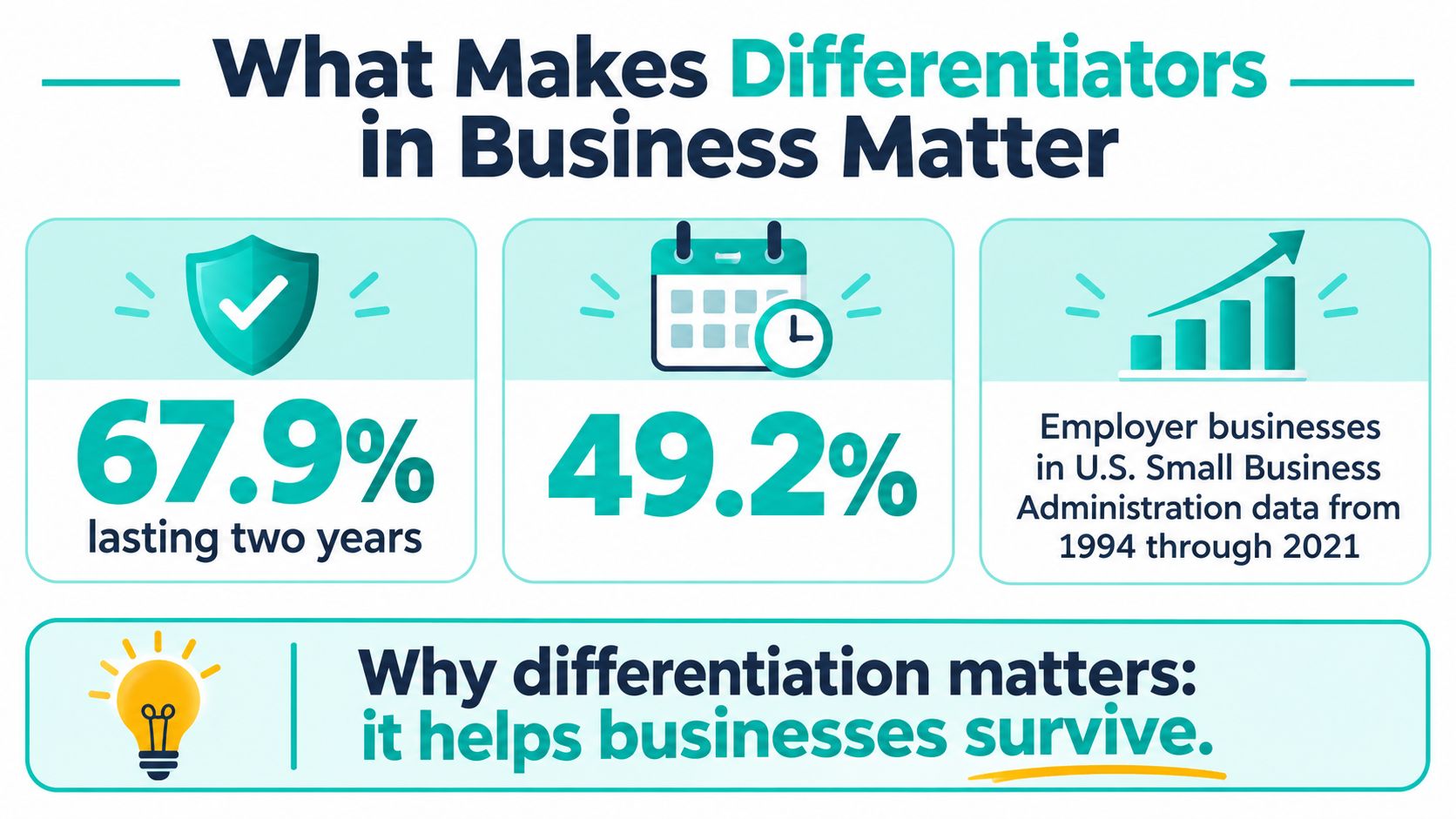
A Census Bureau check tells a similar story in the same SBA summary. Establishments born in 2004 had a 76.4% one-year survival rate, while establishments born in 2000 had a 50.7% five-year survival rate. Different cohorts, same cliff.
A definition you can test
A differentiator is an advantage a customer can name in their own words and a rival can't photocopy by next quarter. "We care more" fails. "Your booking is confirmed before you leave the page, and here's the receipt, the directions, and the reschedule link" passes, because the buyer felt it.
Costumes are easy to spot:
- A cheaper week: A discount a competitor matches before your ad spend settles.
- A new logo: Prettier, but the checkout still asks for a fax number from 2009.
- We use AI: Every rival with a subscription can say the same sentence by lunch.
Real wards look different. Lower friction, faster execution, a smoother journey, rare craft, or a system that keeps learning from real visits. Each one changes what happens on a Tuesday when a tired buyer is holding a phone in one hand and a coffee in the other.
Every mage can throw a similar fireball. The duel goes to the enchantment that doesn't drop halfway across the room.
That's the frame for everything that follows. You'll sort defensible kinds, pick one, prove it with a number, and retire the fake magic. Survival pressure isn't a reason to collect slogans. It's a reason to defend one edge so well that customers notice when it's missing somewhere else.
A Field Guide to Defensible Differentiators
Say a café owner promises quick collection. A customer orders on a phone, sees the same price at checkout, and receives clear pickup instructions. The useful magic is in that sequence. A rival can copy “quick collection” before lunch; making every handoff keep the promise takes more work.
Each row below names a customer moment, the work behind it, and evidence worth tracking.
Defensible differentiators and the proof to watch
| Differentiator | What the customer feels | Hard to copy because | Proof to watch |
|---|---|---|---|
| Smooth experience | The promise holds from discovery to support | Prices, messages, and handoffs must stay consistent | Journey completion, retention, and revenue |
| Speed | Less waiting on a phone | Ordinary visits must perform, beyond a polished demo | Mobile conversion and real-visit loading performance |
| Checkout craft | The purchase finishes without avoidable questions | Steps and offers improve through repeated testing | Cart abandonment and completed purchases |
| Personalization | The next step fits this buyer | Relevance depends on the buyer's situation | Response to relevant appointments, sizes, or refills |
| Specialized craft | This provider understands my exact problem | Niche judgment takes time to develop | Repeat buyers who name the expertise unprompted |
| Trust with controls | Automation stays within clear boundaries | Approval, rollback, and change records must work together | High-risk edits held for review; reversible changes recorded |
How to read the first three rows
Smooth experience means the ad's promise survives the headline, price, email, and support reply. Say the café advertises one price but shows another at checkout. The customer now has a question to resolve before buying. Audit those handoffs: where does the promise change, and where does the buyer stop? Consistency earns its place as a differentiator when you can connect the customer's experience to completion, repeat business, or revenue.
Speed earns its keep while customers wait. A Google and Deloitte analysis of more than 30 million sessions across 37 major-brand websites found that a 0.1-second improvement in mobile load time increased conversion rates by about 8.4% in retail and 10.1% in travel. For a practical benchmark, Google's Core Web Vitals guidance rates Largest Contentful Paint as good at 2.5 seconds or less, needing improvement above 2.5 through 4 seconds, and poor above 4 seconds, assessed at the 75th percentile of visits.
Give this dragon a measurable job: deliver the main content before the buyer loses patience.
Checkout craft concerns what happens after someone wants to buy. Baymard's cart-abandonment research reports averages of 70.19% in its checkout-usability findings and 70.22% across its broader compilation of 50 studies. Unnecessary questions on the payment path deserve scrutiny alongside the landing-page headline. Track whether a tested change helps purchases finish; a prettier checkout alone proves little.
How to read the last three rows
Personalization makes the next appointment, size, or refill relevant to the buyer's situation. CMSWire's account of McKinsey research reports that 71% of consumers expected personalized interactions and 76% were frustrated when companies failed to provide them. A first name in an email offers little protection from rivals. A useful next step gives the customer something concrete to notice.
Specialized craft shows up in the first conversation. Say a tax preparer serves touring musicians, or a plumber specializes in old houses with cast iron stacks. Their questions reveal familiarity with the exact problem. Listen for buyers repeating that expertise to friends without prompting: the customer can describe the advantage without borrowing your slogan.
Trust with controls keeps the learning loop inside its wards. Reversible chores, such as image compression or broken-link repair, can be candidates for automation. Price, legal copy, testimonials, and brand voice need human approval, with a record of changes and a route back.
AI features are easy to copy. The stronger defense is a customer moment you can audit, a test that improves it, and controls that protect the promise while you learn.
How to Cast a Differentiator That Holds
Picking an edge is a procedure, not a vibe. Work these seven steps in order, and watch the trap sitting beside each one.
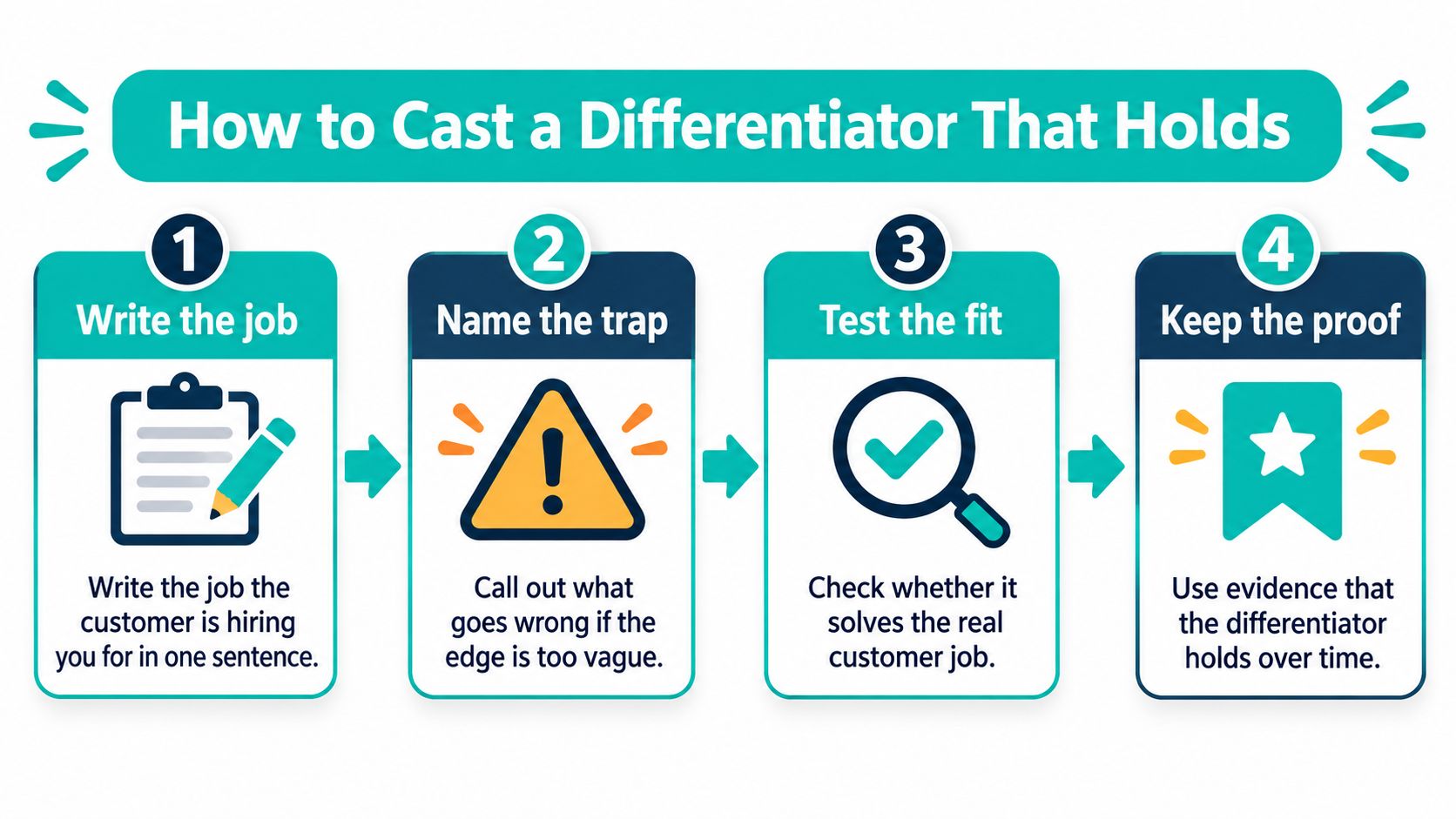
Steps one to four
- Write the job in one sentence. "Get a sales page live before Friday's launch" or "Finish checkout without second-guessing the total." The trap is writing your job instead of theirs. "Increase brand awareness" is something you want, not something a buyer hires you to do.
- List three moments of friction, delay, doubt, or sameness. Say a coach's buyers stall between the webinar and the payment page, reread the guarantee twice, and abandon on phones. Those are three different problems. The trap is writing "the website needs work," which points at everything and fixes nothing.
- Cross out pains three rivals already solve the same way. If every competitor offers free shipping over a threshold and a chat widget, neither one distinguishes you. The trap is keeping a generic "we use AI" line because it sounds current. Current isn't defensible.
- Score what remains on three tests. The customer notices it without a slide deck. A rival needs months, not a weekend, to copy it. You can show a number. The trap is letting a candidate pass on one test because your team loves it. Loving it isn't evidence.
Steps five to seven
- Choose one primary differentiator and one supporting proof. A retailer might pick speed as the edge and checkout completion as the proof. The trap is bundling all six field guide rows into a paragraph that promises everything and commits to nothing.
- Write the customer sentence in their words, plus the metric you won't game. "The product photo is just there when I tap" beats "optimized rendering pipeline." Under it, write the internal number you'll report even when it's ugly. The trap is choosing a metric you can inflate, like page views from a bot-heavy referral source.
- Set a thirty-day test before you celebrate. Write the hypothesis, define the audience, and set the reversal rule if the number moves the wrong way. The trap is deciding after the results arrive what success was supposed to look like. That's not a test. That's a story you tell investors.
Field rule: A pixie can sprinkle features across every page. A working mage picks one ward, maintains it daily, and leaves the rest of the spellbook closed.
Notice what this selection spell doesn't do. It doesn't ask who you are as a brand. It asks what breaks for the buyer, who else already fixes it, and whether your fix survives contact with a calendar and a competitor. Identity is useful later, when you wordsmith the promise. Right now, you're choosing ground worth defending. How you'll judge the thirty-day test, without fooling yourself, is the next discipline.
Proof Customers Can Feel in the Journey
Grade your edge in this order, every time. Business metric first, like revenue, retention, or refund rate. Funnel metric second, like checkout starts or qualified leads. Technical metric third, like load speed. A conversion lift that raises refunds is a false win. A faster page that moves nothing above it is a prettier ward guarding an empty room.
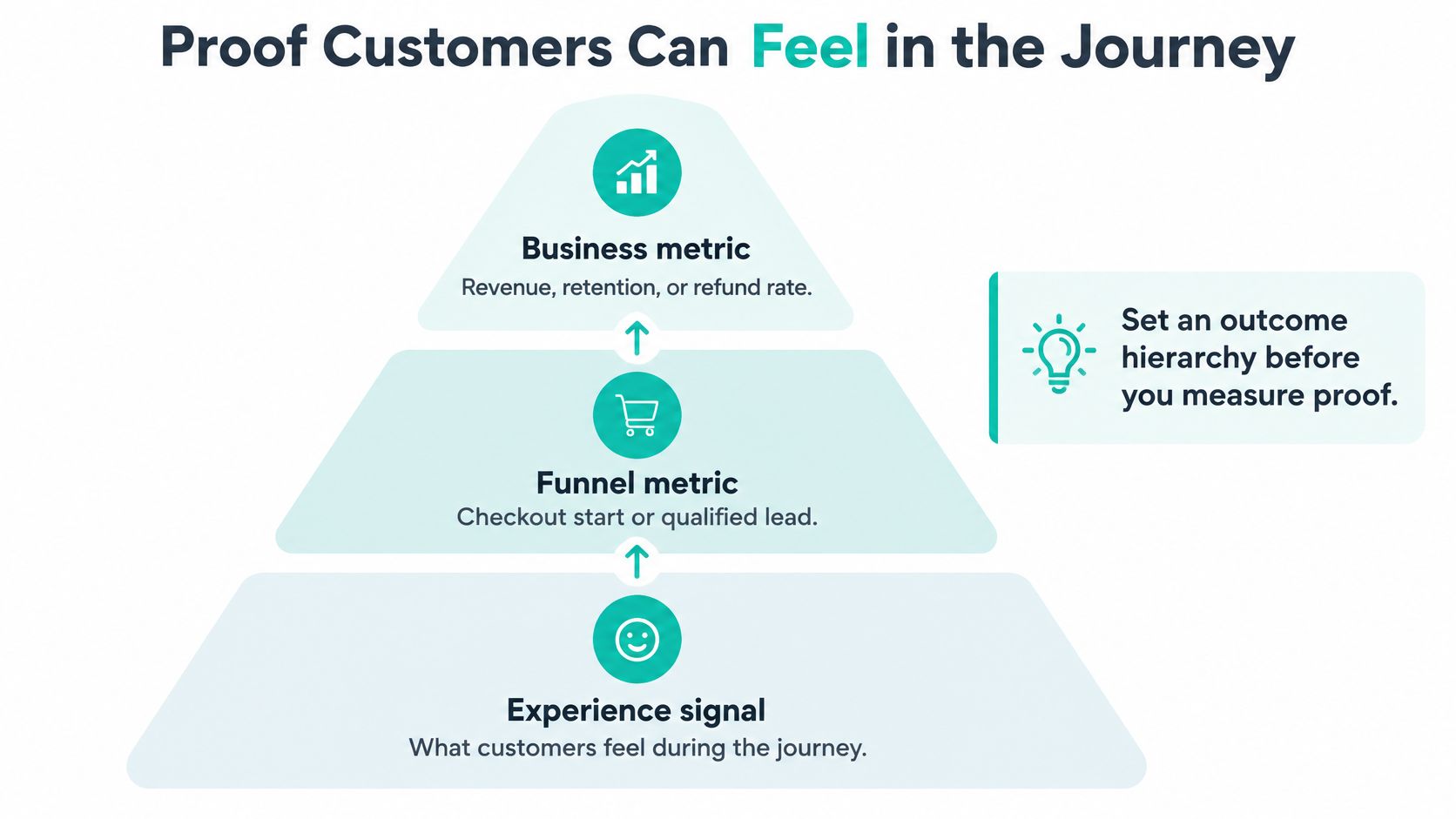
Which metric is allowed to crown a differentiator
| Tier | Example | Let it decide when | It misleads when |
|---|---|---|---|
| Business | Revenue, retention, refund rate | The edge is supposed to pay | Conversion rises while refunds rise |
| Funnel | Checkout start or qualified leads | The leak is a step in the path | Clicks grow and lead quality falls |
| Technical | LCP for 75% of visits over 28 days | Speed is the promised edge | One lab test on a fast connection looks good |
| Experiment | Sample size, interval, guardrails | The lift is unlikely to be noise | A move under about 0.3% is called a win early |
| Learning record | Hypothesis, exposure, reversal rule | The team can repeat the decision | Hours saved produce no written outcome |
Why small lifts demand patience
Most real effects are tiny. Analysis of large-scale Microsoft and Bing experimentation in a controlled experiments paper from the experimentation platform literature reported that treatment effects are rarely above 0.3%. Stop a test early on a cheerful Tuesday and you'll systematically promote noise dressed as insight.
So run the experiment like an auditor, not a fan:
- Name one primary metric before launch: Everything else is commentary.
- Preserve randomization: Balanced exposure first, winner-shifting later.
- Calculate sample size up front: Decide how much evidence a decision needs.
- Watch guardrails: Bounce rate and refund rate can veto a pretty lift.
- Run an A/A check when results smell haunted: Identical variants should perform identically, or your instrumentation is lying.
Retire a variant only after your preset confidence or sequential rule is satisfied. Then keep the record. Audience, sample size, treatment effect, confidence interval, duration, guardrail outcomes. That paperwork is what turns "the AI optimized it" into a decision system a partner can inspect. If you want the user-experience side of this discipline, our guide to conversion rate optimization and UX walks through pairing friction fixes with measurement.
Field data, not lab applause
Speed claims need the same discipline. Google's Search Console Core Web Vitals report defines group LCP as the time by which 75% of page requests reached the largest element during the previous 28 days, good at 2.5 seconds or less, needs improvement at 4 seconds or less, poor above that. One fast run on office wifi proves nothing about a shopper on a train.
Hours saved prove nothing either. Bluevine's study of small businesses found nearly half of SMBs report AI saves them more than four hours per week, while 82% still report roadblocks to deeper integration. Saved time that produces no recorded decision is just a faster way to stay uncertain. Every automated change should keep its hypothesis, audience, exposure, result, confidence, and reversal condition. That's learning speed. That's the spell that compounds.
Differentiators Already Working by Industry
Patterns travel better than slogans. Steal the moment each of these operators changed, not the words on their homepage.
The view below maps those moments across six kinds of businesses.
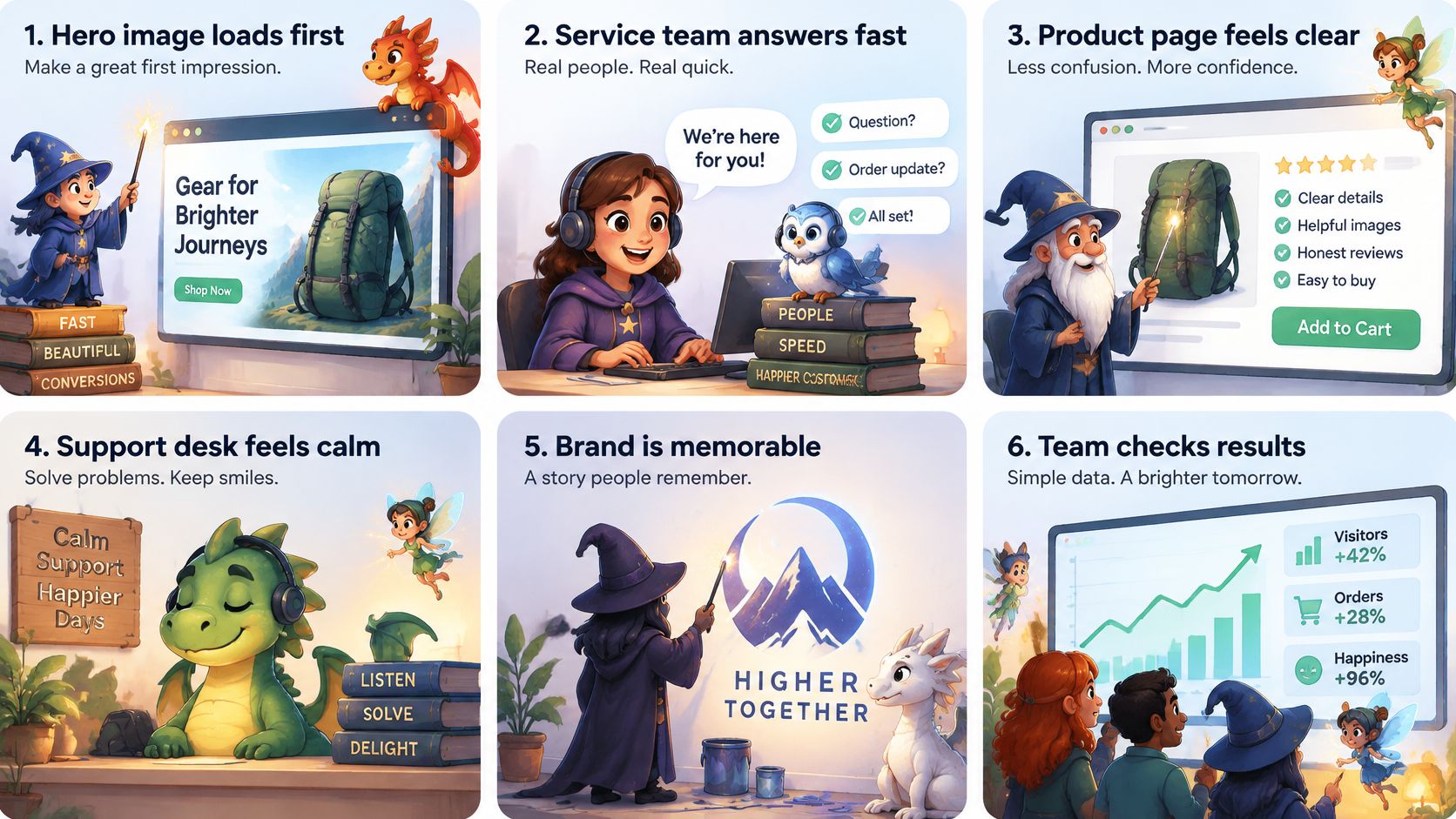
Retail, travel, and direct-to-consumer scenes
Say a retailer sells running shoes. She treats load time as merchandising, so the hero image and price arrive before a commuter's patience runs out, and she judges it on ordinary mobile visits rather than her designer's laptop. Her customer says, "The shoe was just there when I tapped." Nobody says that about a brand value.
A travel seller watches planners vanish between search results and booking confirmation. He removes one anxious step where travelers had to re-enter passenger details they'd already typed. The journey feels continuous now, like a dragon that doesn't land between every village. His customer says, "It remembered everything, so I just paid."
A direct-to-consumer skincare brand stops polishing its landing page. Most carts never become orders, so the team attacks checkout friction instead, testing the order bump placement and trimming the payment path to the fields that matter. The customer line they're chasing is plain. "Checkout took a minute and the total never changed on me."
Course, local service, and SaaS scenes
A course creator shortens the path from webinar to thank-you page. The exact promise made on the call is the first line buyers see after paying, in the same words, so nobody wonders if they bought the right thing. Her buyers say, "It picked up right where the webinar left off."
A local service business, say a dental practice, personalizes the next step in real time. The rebooking offer arrives when the patient's actual recall is due, with times that fit their stated preference for mornings. That bar matters. In Twilio's 2025 State of Customer Engagement Report, 64% of customers said personalized engagement was critical to their buying decisions and 88% said real-time personalization made them more likely to purchase. Inserting a first name doesn't clear it.
A SaaS team's edge is an audit trail. Automated metadata and layout tweaks get logged with before-and-after views, while pricing and product claims wait for a named approver. Their customer, an operations lead, says the sentence every vendor wants. "I can see exactly what it changed and undo it."
This short walkthrough shows how a felt moment, not a feature list, carries a positioning claim into a real page.
One broken moment can erase all of it. PwC's 2025 survey of 5,511 U.S. consumers found 52% had stopped using or buying from a brand because of a bad product or service experience. Each winner above changed a moment the buyer could describe out loud. That's the shared move.
Turn Your Edge Into a Positioning Statement
Compress your chosen row into one sentence a buyer would repeat at dinner. Step one, name the buyer and the job in their words. Step two, name the felt moment from the field guide row you circled. Step three, attach one proof you can show. If you want help hearing buyer language, our notes on copywriting for small business cover mining reviews and support tickets for exact phrases.
For [buyer] who [job], [brand] is the [category] where [felt moment], because [proof].
Four inscriptions, each short enough to carve on a wand:
- Retailer: For mobile shoppers who give up on slow product pages, we are the store where the hero image arrives before patience runs out, because we judge speed on 28 days of ordinary visits.
- Travel seller: For planners who lose a booking between search and confirmation, we are the site where the next step is already on screen, because we removed one handoff and logged the result.
- Course creator: For buyers who stall after a webinar, we are the path where the promise they heard is the first line on the thank-you page, because webinar-to-purchase conversion is tracked weekly.
- Local service: For clients who rebook late, we are the shop that offers the next appointment when it fits their calendar, because real-time offers beat a generic reminder.
Test every line three ways. The customer notices it without a deck. A rival needs months to copy it. A number backs it. Drop any sentence that could describe a competitor word for word, no matter how nicely it sounds read aloud in a meeting.
False Spells Founders Keep Casting
Four claims look like magic and behave like smoke. The first is the unique feature list. Buyers rarely repeat feature lists to friends, and a rival can screenshot yours in an afternoon. If your edge fits in a comparison table cell, it's a spec, not a differentiator.
The second is being the cheapest. A competitor matches a discount by Friday. Meanwhile your thinner margin leaves less money for support, speed work, and the experiments that build a real edge. Cheap is a position anyone can occupy for a weekend and few can survive for a decade.
The AI claim and the trust gap
The third false spell is AI itself. A Bluehost small-business AI study found 87% of surveyed small businesses use at least one AI tool, yet only 20% describe themselves as highly confident using AI and only 6% highly trust AI to write in their brand voice or communicate with customers. The same research summary notes a 2026 survey where 82% of SMBs face barriers to deeper AI integration, led by data-security concerns at 33% and doubts about AI accuracy at 31%.
Adoption is common. Confidence is scarce. So the defensible edge isn't automation. It's control. Buyers ask practical questions. Which decisions run without approval? What stops a misleading experiment? What happens when an automated SEO edit mangles a regulated claim? Answer with a trust matrix, not adjectives.
Trust matrix for autonomous changes
| Action type | Example | Autonomy level | Control required |
|---|---|---|---|
| Reversible | Image compression or broken-link repair | Runs alone | Change log and one-click rollback |
| Metadata | Page title or meta description rewrite | Runs with audit trail | Diff view and rollback |
| High-risk | Pricing change | Waits for approval | Named approver and rollback |
| High-risk | Legal copy or regulated claim | Waits for approval | Human sign-off before publish |
| High-risk | Testimonial | Waits for approval | Source check before publish |
| High-risk | Brand voice rewrite | Waits for approval | Voice review and rollback |
The fourth false spell is shipping faster than you learn. Pages and posts are cheap to produce now. A recorded decision about what the customer did next is not. Drop any candidate that fails noticeability, durability, or proof, even if it gets applause in a pitch. Applause isn't a metric. A warlock who can't show the ward holding is just wearing a costume with better lighting.
Prove One Differentiator in the Next Thirty Days
Take the single row you circled and write one hypothesis. For a named audience, a challenger with a new headline, layout, or offer should move one business metric. Not a pile of vanity numbers. One.
Keep the current page as the control. Decide the sample rule and the reversal condition before any traffic shifts, and refuse to crown a winner because Tuesday looked exciting. If you need the mechanics spelled out, our primer on A/B testing for websites covers allocation and stopping rules in plain language.
The operating rule is simple enough to write on a sticky note. A split test draft is a challenger version of the page with a new headline, layout or offer. Winning split test variants are promoted automatically and losing variants are retired. No orphaned variants, no zombie pages still splitting traffic for months.
For a solo founder, coach, or small team whose differentiator is a faster and more consistent journey, Web Mage is a natural place to run this. A plain-language prompt can produce the page, and the same workspace can draft the challenger, route the test, promote the winner, and retire the loser without a separate plugin stack. Your scarce hours go to reading the result, not babysitting tools.
End the month with a decision line you can defend. One differentiator, one metric, one thirty-day record of what changed and why. If the number doesn't move, the edge was a costume. Retire it without a funeral, open the field guide, and circle the next candidate. Mages who keep honest records eventually cast something that holds.
Your next thirty days need one felt moment, one metric, and a challenger page worth testing, and Web Mage can draft that page from a plain-language prompt, route the split test, and promote the winner while retiring the loser. Bring the row you circled, state your hypothesis, and let the record show whether your differentiator is real magic or just a costume.